
SMA Tarmac Driveway in Heath Hayes, Cannock — finished driveway

Case Study · Heath Hayes, Cannock

SMA Tarmac Driveway in Heath Hayes, Cannock

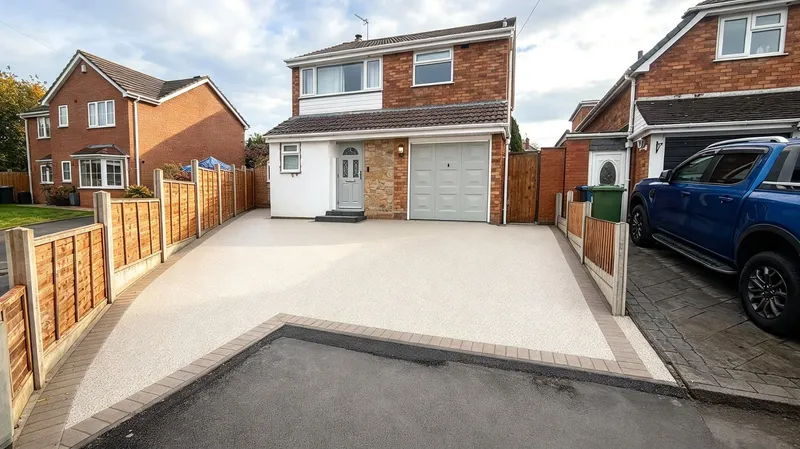
A red block-paved drive lifted and relaid in SMA tarmac — a dense, hard-wearing surfacing mix — with silver grey block edging along the side and across the front.

The Project

From red block paving to an SMA tarmac drive

This house in Heath Hayes, on the eastern side of Cannock, had a drive of red block paving laid in herringbone — the same paving that still runs across the drive next door. We lifted it and laid a new drive in SMA tarmac, finished with silver grey block edging.

The result is one dark, even surface from the road to the garage and the front door, with a single course of silver grey blocks dividing it from the neighbour’s paving and a deeper band of the same blocks across the front where the drive meets the road.

  • Old red herringbone block paving lifted, with a mini digger on site
  • Ground excavated and a compacted base laid ready for the tarmac
  • Silver grey block edging along the side and in a deeper band across the front
  • SMA (stone mastic asphalt) tarmac laid hot, then rolled and compacted
  • Finished drive taped off to keep cars off the fresh surface

Before & After

The same driveway, before and after

Before
After

Before: the old red herringbone paving coming up, with the digger in position. After: one SMA tarmac surface, edged in silver grey blocks.

Before

Taking up the old block paving

The drive was red block paving in a herringbone pattern, matching the drive next door. The before photo catches the job just under way: the mini digger in position at the front and the team lifting the old blocks by hand and stacking them by the garage.

Lifting block paving is a methodical job rather than a quick one. The blocks come up first, then the bedding sand and whatever lies underneath, until the ground is down to the level the new construction needs. Only then does the new base go in — on a tarmac drive, a compacted layer of aggregate, levelled to give the surfacing an even, solid bed.

Getting that stage right matters more on tarmac than on most surfaces. Tarmac follows whatever is underneath it, so a dip or a soft spot in the base shows straight through the finished drive as a puddle or a hollow.
The surface

Why SMA tarmac

SMA stands for stone mastic asphalt. Unlike the standard dense mixes used on many drives, it is gap-graded: a high proportion of coarse stone that locks together into a stone-on-stone skeleton, with the gaps filled by a rich mastic of bitumen and fine filler. Fibres are added to the mix so the binder stays where it should while the material is transported and laid.

That stone skeleton is what SMA is known for. It resists deformation — the ruts and scuffs that come from tyres turning on the spot and cars parked in the same place day after day — which is why it is widely used on heavily trafficked roads. On a drive it gives a dense, dark, closed finish, as the photos show.

Like any tarmac it is laid hot, spread evenly over the prepared base, then rolled and compacted. Once it was down, this drive was taped off so nothing drove onto the fresh surface. There is more on surfaces and finishes on our tarmac driveways page.

The edging

Silver grey edging against black tarmac

Tarmac needs a firm edge. It is rolled and compacted against whatever holds its sides, and an unrestrained edge has nothing to compact against, so it is the first part of a drive to crumble. A course of block paving set on a solid base gives the tarmac that edge, and gives the drive a clean outline.

Here the silver grey blocks run in a single course down the side, where they divide the new drive from the neighbour’s red paving, and in a deeper band across the front where the drive meets the road — the edge that takes every car going in and out. The pale grey makes a sharp contrast with the black SMA and picks up the grey of the gates and the front door.

We lay the same kind of borders on block paving and resin drives too — see kerb edging.

Heath Hayes

Tarmac driveways in Heath Hayes

Heath Hayes sits on the eastern side of Cannock, in Cannock Chase district. Together with Wimblebury it forms the civil parish of Heath Hayes and Wimblebury — two villages that housing has gradually joined into one.

Planning in Heath Hayes is a matter for Cannock Chase Council, while the roads and pavements, dropped kerbs included, belong to Staffordshire County Council as highway authority. A new or wider dropped kerb needs Staffordshire’s approval as a vehicle access crossing before any work starts on the pavement; the standard width is 2.75 metres, and the county will not approve a crossing that takes up the whole width of a property.

Planning permission is worth thinking about with tarmac in particular. Standard tarmac does not let water through, so covering more than five square metres of a front garden with it needs permission if the rainwater runs onto the road, but not if it drains to a lawn or border on the property. That is why the falls and the drainage are settled at the quote, not halfway through the job — see our drainage page.

We lay tarmac, resin and block paving drives across Cannock and the surrounding areas — see the areas we cover.

Your Questions, Answered

Tarmac driveways in Heath Hayes: your questions answered

Your Local Experts

What our customers say

Independent reviews of Marshall Driveways Ltd on TrustATrader and Google.

Get Started Today

Want More Information? Get A Free Quotation.

Free, no-obligation quotes for driveways, patios and paving across Wolverhampton, Cannock and the surrounding areas.

WhatsApp